Granite and Sandstone: Two Stones, Different Clues
Granite and sandstone reveal different grain, texture and weathering clues; learn how to describe a stone carefully without relying on appearance alone.
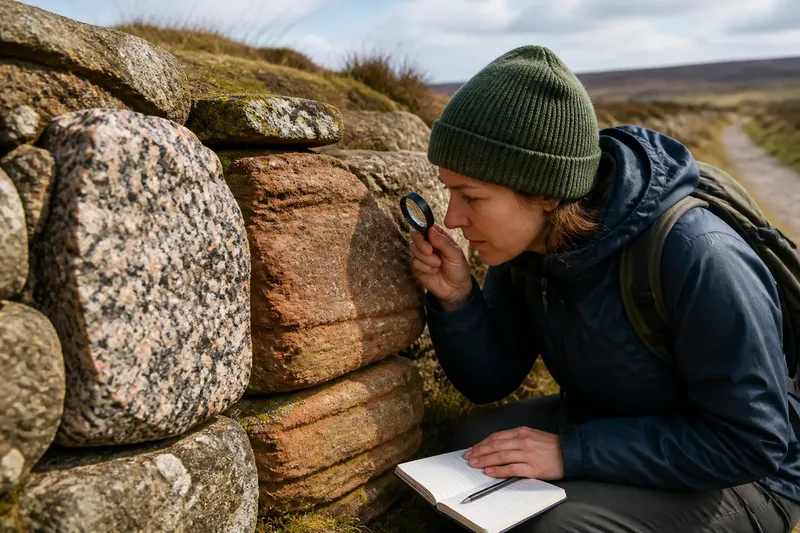
The common mistake when comparing granite and sandstone is to name a stone from one striking feature: a pale patch, a dark fleck or a rough face. That can turn a useful field description into a shaky identification. Granite and sandstone offer different visible clues, but surfaces weather, stain and break in ways that can disguise them.
Use the following observations to describe what you can see, then keep the rock name provisional unless you have stronger evidence.
1. Look for grains, not just colour
Granite commonly shows a close-set mixture of visible mineral grains. In a fresh or lightly weathered face, you may see pale, glassy-looking quartz, lighter feldspar and darker minerals such as mica or hornblende. The grains fit together without an obvious sandy matrix between them.
Sandstone is made of sand-sized grains held together by a natural cement or finer material. Its grains may look like tiny rounded or angular particles, often set in a background that differs in colour or texture. Some sandstones have grains large enough to pick out individually; others appear nearly uniform until you look closely.
Do not use colour as a shortcut. Granite can be pink, grey, cream or dark, while sandstone ranges through buff, red, brown, grey and other shades. Iron staining, lichens, wetness and the angle of light can all alter the surface colour. Record the colour, but pair it with grain shape and arrangement.
2. Notice how the grains meet
In granite, the component crystals usually meet along irregular boundaries, making a tightly interlocked pattern. A hand lens can help distinguish individual mineral grains, but the texture is often visible to the unaided eye. Look for repeated contrasts between pale and dark minerals rather than assuming every fleck is a separate grain of sand.
In sandstone, grains tend to read as separate particles, even when cement binds them firmly. The gaps may be filled with silica, calcite, iron compounds or finer sediment, so the stone need not feel loose or crumbly. A rough surface can reveal the granular fabric; a smooth, worn face may conceal it.
Describe the relationship you see: “interlocking pale and dark crystals” is more useful than “speckled”; “distinct sand-sized grains in a reddish matrix” says more than “rough”. Such wording preserves the observation even if a later identification changes.
3. Check whether the surface is fresh or weathered
A freshly exposed break often shows texture more clearly than a face exposed to rain and frost. On granite, weathering can loosen minerals at different rates, leaving a gritty surface or rounded edges. Feldspar may become dull or crumbly, while tougher quartz grains remain prominent. A weathered face can therefore look less tightly interlocked than the rock beneath it.
Sandstone may also change at the surface. Cement can weaken, grains can be released, and water can carry away fine material. This may leave a sandy feel or shallow hollows. Yet some sandstone is well cemented and remains hard, while some granite breaks down into coarse grit. Neither “crumbly” nor “hard” settles the identification by itself.
Compare sheltered and exposed faces if both are visible. A protected edge beneath an overhang may retain sharper grain detail, while a rain-washed face may have softened it. Do not chip or scrape a building stone or a natural outcrop to obtain a better view.
4. Read weathering patterns with care
Granite often develops rounded forms as corners and exposed edges weather back. Its different minerals respond unevenly, so small pits and rough patches can form where less resistant grains have been removed. These patterns may be clear on a boulder but less obvious on a cut block or a surface coated with lichen.
Sandstone may show bedding: roughly parallel layers or changes in grain size that reflect how sediment accumulated. It can weather into ledges, shallow grooves or recesses along weaker layers. Thin flakes may separate in some stones, but this is not a universal sandstone pattern, and joints or later damage can create similar shapes.
Look at the larger arrangement as well as the small surface. A line that continues across a broad face may be a bedding plane, a joint or a construction seam. Describe its direction and appearance without assigning a cause unless the evidence is clear. A single cavity or split is rarely enough to identify either rock.
5. Describe the texture in plain language
Field notes work best when they separate direct observation from interpretation. A useful entry might record the setting, the surface condition, visible grains, colour and any layers. For example: “Grey block, damp and lichen-marked; pale and dark crystals visible on a chipped edge; no clear bedding.” That is a stronger record than “granite” if the identification is uncertain.
Say you are looking at a low wall beside a northern footpath. The face is rusty brown and coarse, but a sheltered corner reveals separate pale grains in a darker background, with a faint line running across the block. You could note “brown, granular stone with possible layering” rather than call it sandstone at once; the description remains useful even if the line proves to be a joint or the stone turns out to be another rock.
For quick notes, choose terms that point to visible features:
- Grain size: fine, medium or coarse, with “visible to the eye” where helpful.
- Grain arrangement: interlocking crystals, distinct particles or indistinct texture.
- Surface state: fresh-looking, weathered, damp, stained or lichen-covered.
- Structure: no clear layers, possible bedding, or a visible joint.
- Weathering: rounded edges, pits, loose grains, ledges or shallow hollows.
6. What should you check before naming the stone?
Can granite contain grains that look like sand?
Yes. Its mineral crystals vary in size, and a weathered face may leave individual grains standing proud. Check whether the minerals form an interlocking mix and whether pale and dark crystals recur across the surface.
Does every sandstone show obvious layers?
No. Bedding can be faint, hidden by weathering or absent from the small face you can see. Look for repeated changes in grain size or parallel bands, but describe them as possible layering if the evidence is limited.
Can colour identify granite or sandstone?
No. Both rocks occur in varied colours, and surface staining, moisture and biological growth can change what you see. Treat colour as one descriptive detail, not a verdict.
What if the rock does not fit either description?
Keep the description open and record the visible clues instead of forcing a choice. Other rocks can have granular textures or layered appearances, so a reliable name may require closer examination by someone with geological expertise.
7. Leave the elaborate tests aside
For an ordinary walk, there is little value in carrying tools to scratch, break or chemically test an unknown stone. Such methods can damage a natural feature or building material, and they may introduce hazards. A small hand lens, a notebook and careful observation are usually enough for a useful field description.
If a rock is part of a wall, monument or protected outcrop, leave it intact. Where exact identification matters—for conservation, building work or a geological record—ask a suitably qualified professional to assess it in context. For everyday field notes, the best granite and sandstone clues are the ones you can describe plainly: how the grains look, how they meet and how the exposed surface has changed.
On your next walk, write the observations before the name. That small habit makes granite and sandstone descriptions more accurate, and it keeps uncertainty visible rather than hiding it behind a confident label.