A Valley in Cross-Section: Reading Its Slopes and Floor
A valley cross-section helps you describe slopes, benches and the floor clearly, while keeping the shape separate from assumptions about how it formed.
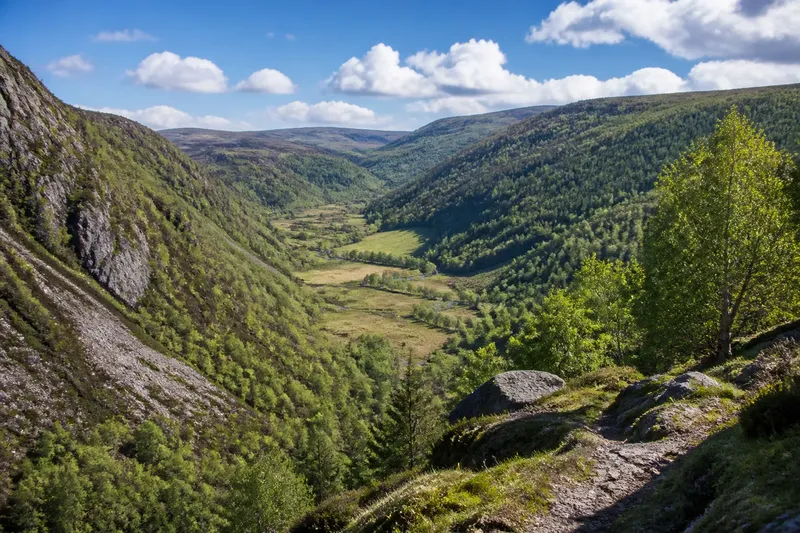
The common mistake in reading a valley is to call it a V or a U before looking at the ground between the sides. That shortcut can hide shoulders, shelves, uneven floors and changes from one side to the other. A valley cross-section gives you a clearer description: trace the land from one slope, across the floor, and up the opposite slope, without treating its outline as proof of how it formed.
This approach is useful in northern landscapes, where a short walk can take you from a steep rocky side to a broad, damp floor or a wooded shelf. Your task is to decide what kind of cross-section you need, what features to record and how far your observations support an explanation.
What are you trying to describe?
Choose your purpose before sketching. A cross-section can record a visible shape, compare two points along a valley, or help you frame questions about landforms. These are related jobs, but they call for different levels of detail.
- For a quick description: note the overall width, the steepness of each side and whether the floor is narrow, broad or difficult to distinguish. This is enough for a field note or a conversation about the valley’s appearance.
- For a comparison: draw sections across two or more locations, keeping their direction consistent. This helps show where a valley becomes wider, where one side grows steeper, or where a shelf appears.
- For an interpretation: record the shape first, then list possible explanations separately. A cross-section can make an idea easier to examine, but the outline alone does not identify the process that produced it.
For a basic sketch, use a notebook and pencil. Add a compass or a map if you need to note the direction of the section; use a phone photograph or a simple line drawing to preserve visible details. A drawing is a record of what you can see from a chosen position, not a scale survey unless you have deliberately made it one.
Where should the section cross the valley?
Pick a line that cuts across the valley rather than following its length. A section taken along the valley floor will show its route, not the full relationship between the opposing slopes. If the valley bends, use a line across the local direction of the valley at your chosen point.
Choose a place where you can see enough of both sides to compare them. A safe viewpoint may be set back from the floor or reached by a path above it. Do not enter a steep bank, unstable edge or watercourse just to make the sketch look complete. If trees or buildings block the view, record the obstruction and choose another position if one is readily available.
Where a valley changes character, one section may not represent the whole. A narrow stretch, a wider reach and a place where a tributary joins can have different shapes. Treat each as its own observation rather than forcing them into a single ideal outline.
How do you read the slope and floor?
Start at one side and follow the profile in order: upper slope, middle slope, lower slope, floor, then the opposite side. Mark transitions rather than drawing a smooth curve by habit. A shoulder may interrupt the descent; a bench may form a relatively level strip; a steeper face may drop to a flatter area at the foot.
Describe the two sides separately. One may descend gently while the other is steep or stepped. Calling the valley symmetrical would discard that difference. Use plain terms such as steep, gentle, convex, concave, stepped and irregular, and say where the change occurs.
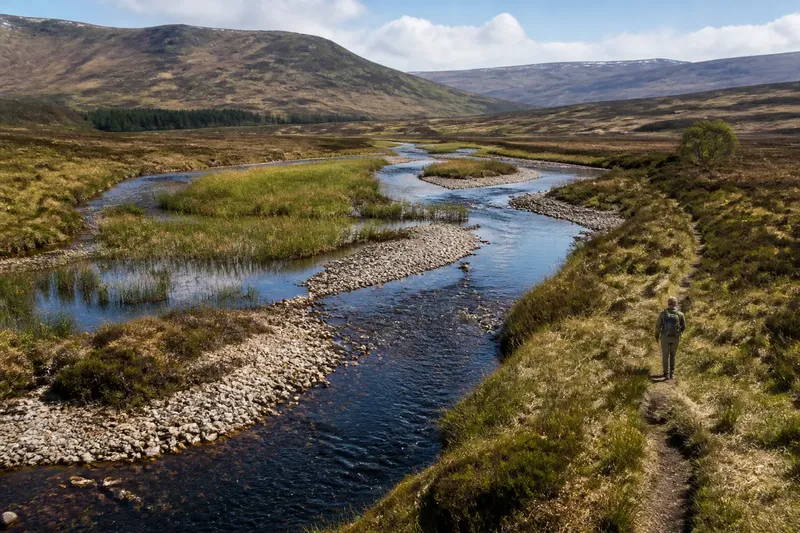
The floor is not always a flat strip. It may be narrow, broad, gently sloping, uneven or partly hidden by vegetation. A stream, wet hollow, gravelly patch or raised ground can help you locate parts of it, but do not let one feature stand for the whole floor. Note what is visible and what is concealed.
A useful sketch needs only enough detail to make the transitions clear. Label the valley sides, the floor, any conspicuous benches or shoulders, and the direction of the section. If you cannot tell where a slope ends and the floor begins, mark the boundary as gradual or uncertain instead of drawing a sharp line.
What should you do in different field situations?
If both slopes are visible, draw the whole profile and compare the two sides. This is the clearest situation for describing the valley’s overall cross-section, though it still does not explain its origin.
If woodland blocks one slope, sketch the visible side and floor, then mark the hidden section as unseen. If the shape matters to your question, seek another viewpoint rather than filling the gap with a guessed curve.
If the floor is broad or broken, show its changes instead of reducing it to a single flat line. Note any low hollows, shelves or gently rising ground that can be distinguished from the valley sides.
If the valley looks like a simple V or U, use that as a brief visual comparison, not a full explanation. Add the actual features that support the description, such as a narrow floor, a broad floor, steep sides or rounded transitions.
Say you are looking across a wooded northern valley from a path, and the near side has a steep lower face while the far side disappears behind trees. You can sketch the visible descent, mark the floor and label the opposite slope as obscured. The resulting record describes what is available to inspect without pretending the unseen side matches the near one.
What can a cross-section tell you, and what can’t it?
A cross-section is strong at describing form. It can show where a valley is narrow or broad, whether the sides differ, and whether benches or changes in slope interrupt a simple outline. Comparing sections can reveal that the valley’s shape changes along its course.
It is weaker as a stand-alone account of origin. Valleys can be shaped by different processes, and similar-looking profiles need not have the same history. A rounded outline is not, by itself, a verdict about glacial action; a V-shaped outline does not establish that a river alone produced the whole valley.
Keep observation and interpretation in separate notes. For example, record “steep sides, broad uneven floor” before considering what processes might fit. Then look for other evidence in the wider landscape, such as the arrangement of tributaries, exposed materials or landforms beyond the section. Those clues may help frame an interpretation, but the cross-section should not be made to say more than it shows.
Do not spend effort smoothing every small bump into a polished curve. A neat line can look more certain than the view warrants. The useful work is marking the main changes and noting where visibility or access limits the description.
Which questions help you choose the next observation?
Does a V-shaped valley always come from river erosion?
No. The outline describes a shape, not a complete history, and several processes can contribute to a valley’s form. Record the profile first and use other landscape evidence before proposing an origin.
What makes a valley floor different from a bench?
A floor is the lower area between the valley sides; a bench is a shelf or relatively level break within a slope. A broad floor can still be uneven, while a bench may sit above it partway up the side.
Should I draw both sides if one is hidden?
Draw what you can see and mark the hidden section as obscured. If comparing both sides is central to your purpose, find a clearer viewpoint rather than assuming the unseen profile.
How many cross-sections are useful along one valley?
Use enough to represent the changes relevant to your question, not a fixed count. A section at a narrow reach and another where the valley opens out can be more informative than several sketches of nearly identical ground.
How do you make the description useful later?
Write a short caption beside the sketch: where you stood, which direction you looked, what was visible and what was hidden. If you compare locations, give each a distinct label and keep the section direction clear. These notes make it easier to understand the drawing when the view is no longer in front of you.
Use the phrase “valley cross-section” when you want to describe this across-valley profile, then qualify it with the features you actually observed. A precise account can be modest: an uneven floor, one steep side, one partly obscured side. That is more useful than assigning a familiar valley type and leaving the reader to guess what the land looked like.