A Winter Walk for Reading Bare Branches
A winter walk for reading bare branches helps you notice tree form, spacing and woodland structure without relying on leaves or species names.
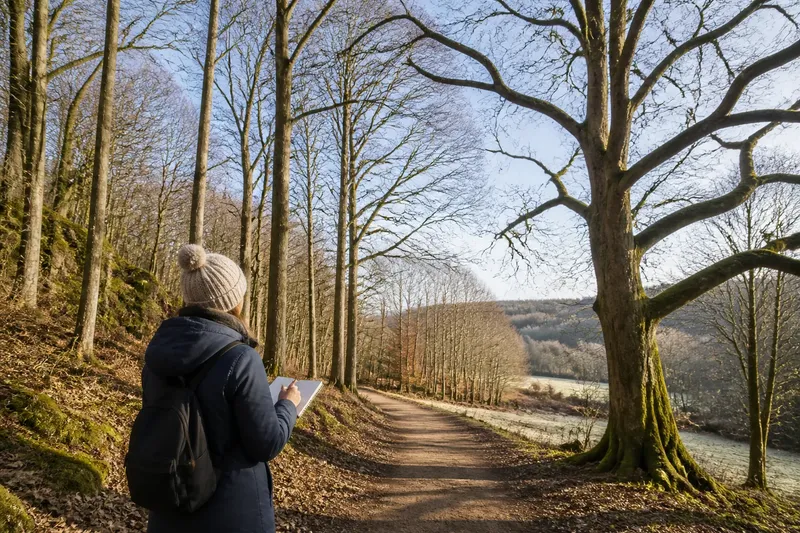
The common mistake on a winter walk is to look up at a canopy as if every tree were a separate drawing. A winter walk for reading bare branches works better when you begin with the ground beneath them and gradually widen your view; otherwise, tangled outlines can hide the woodland’s structure.
Where should you begin the walk?
Choose a familiar path with a safe place to pause, ideally where trees stand both beside and farther from the track. A woodland edge, a gap between stands, or a path through mixed trees can all offer useful views. You do not need to know the species. The aim is to observe how branches grow and how trunks are arranged.
Before setting off, take a small notebook and pencil if you like making quick sketches. Keep your phone in your pocket unless you want a photograph for later comparison. Look for a route where you can stop without blocking other walkers, and keep to the path rather than stepping among roots or across fragile ground.
What can you learn by looking from the path?
Start with the nearest trees. Notice where each trunk divides into major limbs, whether those limbs rise steeply or spread sideways, and whether the crown looks balanced or leans towards an open space. Follow one large branch with your eyes from its junction to its finer tips. This slows the view enough to distinguish a tree’s main structure from the smaller twigs that cross it.
Now compare nearby trees without trying to name them. Some have a clear central trunk continuing upwards; others split low into several substantial stems. A tree beside a path may have an open side where people or light have shaped its growth, while a tree growing among neighbours may carry its fuller crown higher up.
Look for repeated shapes as well as exceptions. Several trees may share upright trunks but differ in how widely their upper limbs spread. One crooked tree can be interesting, but the surrounding pattern tells you whether it is a local oddity or part of a broader stand shape.
How should you read the gaps between trees?
Shift your attention from individual crowns to the spaces around them. From the path, pick a distant trunk and notice whether nearby trunks partly hide it or leave a clear opening. Then look sideways along the stand: are trees evenly distributed, clustered in small groups, or separated by broad gaps?
Spacing changes the way branches appear. In a crowded patch, crowns may press together and lower limbs may be sparse. Near an opening, branches can extend into the available space, making the edge of the canopy look uneven. These are visible relationships, not a reliable way to identify why a particular tree grew as it did.
To make the pattern easier to see, briefly use one trunk as a frame. Look past its left side, then its right, and compare the number of visible trunks and the width of the openings. Avoid treating the view as a precise count: overlapping branches and the curve of the path can make distances deceptive.
What should you follow as the path changes?
Continue at an unhurried pace, stopping where the woodland’s outline changes. A bend may reveal a gap that was hidden before; a rise in the path can bring upper crowns into view. At each pause, ask the same simple questions: which trunks stand closest, where do their main branches begin, and what shape does the open sky take between crowns?
Compare the edge of the woodland with its interior. Trees at an edge often show more exposed sides and wider-reaching branches, while trees within a dense stand may form a more continuous upper layer. Look for transitions rather than assuming the whole wood has one uniform arrangement.
Say you reach a small clearing with a cluster of young-looking slender trunks at one end and a broad-crowned tree at the other. You could sketch the trunks as simple vertical lines, mark the clearing as a blank space, and add the main limbs as angled strokes. The sketch should make the contrast in spacing and crown form easier to remember, without claiming anything about the trees’ age or history.
Which details are easy to overlook?
Notice where branches stop and where they continue. A broken-looking outline may come from a natural fork, a snapped limb, or overlapping crowns; from a path, the cause may not be clear. Record only what you can see. Also check whether the crown is visible against open sky or merges into a dark background, since contrast can make some branch patterns appear stronger than others.
It can help to compare the same view from two points a few paces apart. A small shift may reveal that a supposed fork belongs to the tree behind it. Do not spend time trying to untangle every crossing twig; that is not worth the effort. The larger limbs and the spaces between trunks carry the useful pattern.
What questions help you keep looking?
Can I read bare branches without identifying the trees?
Yes. Focus on trunk divisions, limb direction, crown shape and the spaces between neighbouring trees. Species names can add context, but they are not needed to describe visible form.
Why do some trees have fuller crowns on one side?
Open space, nearby trees and the tree’s position along an edge can all affect the outline. Treat these as possible influences rather than deciding on a cause from one view.
Should I sketch the whole woodland?
No. A small section with a few trunks, major branches and one clear gap is easier to read later. Keep the drawing simple enough that it records relationships rather than every twig.
What if branches overlap too much to follow?
Change your position slightly or choose a single trunk as your focus. If the view remains tangled, move on and look for a cleaner outline rather than forcing an interpretation.
How can you finish the walk with a useful record?
Before leaving the path, look back at one view you have already observed. Notice whether your attention now moves from trunk to crown and then across the gaps, instead of stopping at a jumble of twigs. In your notebook, write a few plain observations such as “crowns meet above the path” or “wide opening beside the clustered trunks”. These descriptions preserve what was visible without turning guesses into facts.
A winter walk for reading bare branches is most rewarding when you leave room for uncertainty. The outline can show where a tree stands, how its limbs spread and how the woodland is spaced; it cannot, on its own, tell you the full story behind those forms. Take that distinction with you, and a familiar path can offer a sharper view each time you walk it.